![[personal profile]](https://www.dreamwidth.org/img/silk/identity/user.png) sharplittleteeth
sharplittleteethJust finished A Visit from the Goon Squad, by Jennifer Egan.
"Time's a goon," says one of the characters in it. And no one survives a visit unscathed.
It's not a conventional novel. It's more a series of intertwined short stories, centred around punk-rocker-turned-record-label-owner Bennie Salazar and his kleptomaniac assistant Sasha, but spreading out encompass their friends, families, and lovers.
Time is the central theme here, the way it gnaws away at us, the way our our fortunes shift and writhe with the years, the thin connections we form and then time tears apart. The stories jump around, from the present to 1970s to the near future, and vary from the absurd (a disgraced PR agent scores a genocidal dictator as a client) to the small and sad (a teenage girl writes a PowerPoint presentation about her father's struggles with his autistic son).
The constantly changing viewpoints meant this book never gripped me the way that, say, the last David Mitchell book did. The prose style changes with each chapter, and I felt it varied from the merely adequate to the exquisite (the PowerPoint slide chapter sounds gimmicky, but is crystalline in its beauty).
Egan won the Pulitzer Prize for Fiction for this book. It's a good book. An inventive book, and a moving one.
Is it a great book?
I'm not sure. Many people think so - see the Guardian review linked above, or the Pulitzer Prize it won. It didn't blow my mind the way the aforementioned David Mitchell book did. But I'm glad I read it. You should read it too. I think you might like it. Egan's great strength here is to take absurdist and comedic situations, and make them feel frail and human.
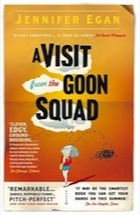
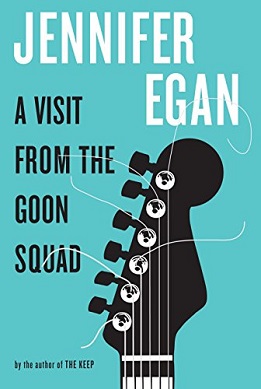
(The cover, though, is awful. They had two different versions in Readings, and both were horrible. I wish they had to good cover, with the electric guitar.)
"Time's a goon," says one of the characters in it. And no one survives a visit unscathed.
It's not a conventional novel. It's more a series of intertwined short stories, centred around punk-rocker-turned-record-label-owner Bennie Salazar and his kleptomaniac assistant Sasha, but spreading out encompass their friends, families, and lovers.
Time is the central theme here, the way it gnaws away at us, the way our our fortunes shift and writhe with the years, the thin connections we form and then time tears apart. The stories jump around, from the present to 1970s to the near future, and vary from the absurd (a disgraced PR agent scores a genocidal dictator as a client) to the small and sad (a teenage girl writes a PowerPoint presentation about her father's struggles with his autistic son).
The constantly changing viewpoints meant this book never gripped me the way that, say, the last David Mitchell book did. The prose style changes with each chapter, and I felt it varied from the merely adequate to the exquisite (the PowerPoint slide chapter sounds gimmicky, but is crystalline in its beauty).
Egan won the Pulitzer Prize for Fiction for this book. It's a good book. An inventive book, and a moving one.
Is it a great book?
I'm not sure. Many people think so - see the Guardian review linked above, or the Pulitzer Prize it won. It didn't blow my mind the way the aforementioned David Mitchell book did. But I'm glad I read it. You should read it too. I think you might like it. Egan's great strength here is to take absurdist and comedic situations, and make them feel frail and human.
(The cover, though, is awful. They had two different versions in Readings, and both were horrible. I wish they had to good cover, with the electric guitar.)